Nels Wadycki

Writes Code, Fiction

  • So I’ve been struggling writing what I guess is the second-to-last part of Valkyrie Project 3 (as yet untitled). This sort of fear of the unknown has significantly dampened my enthusiasm for writing this story. So, this morning I said “Suck it up!” and just sat down and pushed my way through a scene for almost an hour, doing a lot of internal character “thinky” stuff while in my mind I did my own “thinky” stuff about what Ana was going to do when she was done lamenting her circumstances. (That’s a whole different story) I had to go through a ton of iterations (just mentally) but I finally hit on something that I really like. Now when I think about it, I’m acutally excited to go back and fill in some foreshadowing and write a couple other scenes I’d been putting off!

    Also, in searching for an appropriate image to go with this post, I kind of realized that I’m unintentionally writing an Urban Fantasy novel. I think in some sense, that’s what I’ve been doing all along… Just writing really techy urban fantasy. Which also makes sense since Shadowrun was one of my favorite settings growing up (even though I only actually played the game like once).

    For a more quantitative update, I’m up to 61,000 words, which means I’ve done 11,000 words for VP3 since my May 2nd post at 50,0000. Only 2,444/month, but that’s better than the 926 I averaged in the 6 months before that. My rough goal based on what I know I need to write is 83,000, so if I continue at 2,444, that’s 9 months. Yikes. Luckily, the next 3.5 months include NaNoWriMo and a generally higher overall output (yes, I track this on a spreadsheet). I’ve been averaging 6,000+ so far this year; just haven’t dedicated all that to VP3. Now that I’m in a better headspace about it, I should be able to crank out 22,000 words in the next 2 months. Does that mean it’ll be ready for revisions? I don’t know. I might find a bunch of scenes that I’ve left out once I read through it. TVP and WTP were both closer to 100,000 words, and VP3 feels like a bigger book than either of those, so I have this nagging feeling like I’m missing some connective tissue around all the bones of the story.

    Okay, that was a lot more than I initially intended to write, so I’m going to stop there. Back to the words that matter. 😀

    PS: Sorry for the lame blog post title. This started as a Facebook post where you don’t need a title… Which is probably what led to the scattershot braindump.

  • Remember The Milk Logo

    Several times already since February when the new version of Remember The Milk came out, I’ve considered moving my “Work” to do list into it, merging it with all of my personal tasks. I’ve loved Remember The Milk for a long time even when it’s design was questionable and there was no native (or “native”) app. But when RTM made a huge update to all their apps, they definitively reasserted their competitiveness in the field of To Do List Apps (despite the fact that they’re an 11 person organization and three of their employees share a last name with the two co-founders and one of the 11 people is a stuffed monkey).

    Much like Rands (aka Michael Lopp), I try out productivity solutions whenever I hear of a new one. The main reason I’ve been so hesitant to move my Work Stuff into Remember The Milk is because I feel like I need the separation there. On the evenings or weekends, or even when I just want to see if there’s any personal stuff I can knock out, I don’t want to have to see all the work stuff that I need to do. I still think about it… Especially as we approach the start of a new year and I think about all the ways I can procrastinate by pretending I’m becoming more efficient continue my journey of self improvement. But in the mean time, here’s why I think that the new Remember The Milk is the solution.

    (Note that this post is not intended to convince anyone to start pursuing a path toward a productivity system, or dictate how such a system should work. It pretty much assumes that you already use one or more apps or that you have some sort of productivity system already in place. It’s also not a step-by-step how-to because you can get that other places and it would take me forever to repeat what others have done better. This is mostly just to promote Remember The Milk because I use it and love it.)

    It Feels Solid, Yet Easy To Use

    I know this is very difficult to quantify and/or qualify objectively, but it’s also the most important thing for me when I am essentially unloading my mind into “the cloud.” I want an app that feel like scaffolding on which I can build a skyscraper of productivity. Or, since it’s that time of year, a tree on which I can hang bright lights and shiny ornaments and have people marvel at how I have it up right after Thanksgiving. I don’t want something that feels like scaffolding on a rainy or icy day. Oh, sorry… continuing the wrong metaphor. I don’t want an app that feels like a stocking full of little trinkets where I have to unpack the whole thing to find what I’m looking for.

    With Remember The Milk, I don’t get the feeling that I’m going to lose or misplace something (in the digital realm at least). Remember The Milk isn’t the only app I’ve tried that feels solid and secure. Most of those that give me that feeling, though, also feel cumbersome, like there’s a trade-off between feeling like To Do items won’t get lost in a red velvet sock filled with them and the ability to quickly add new items.

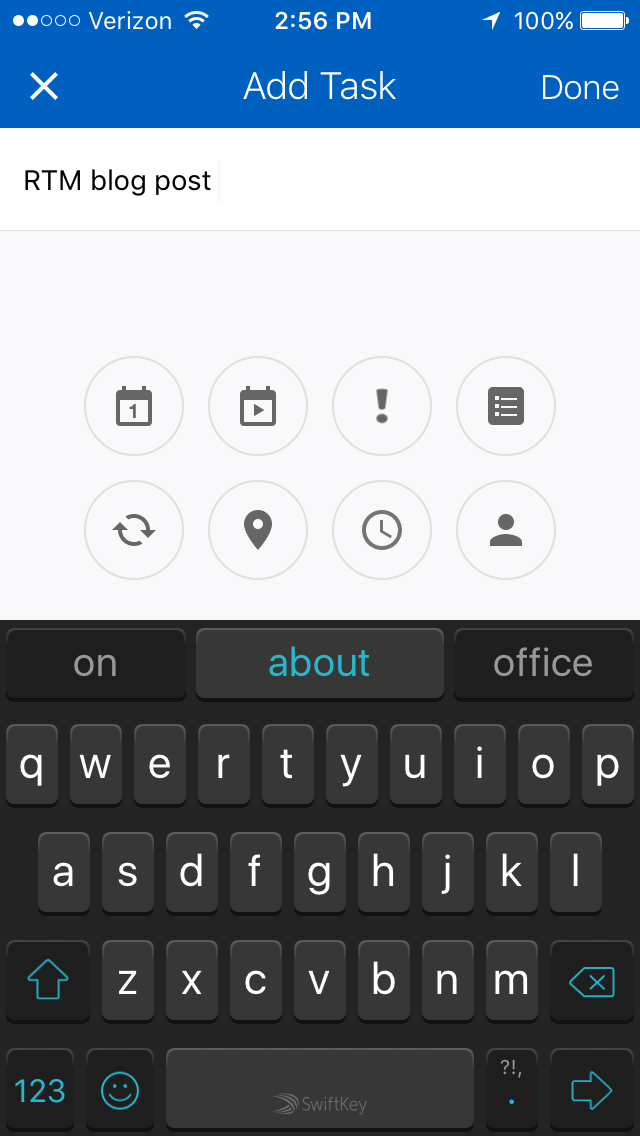
    Remember The Milk makes entering new tasks easy, fluid, almost frictionless, whether you use the short cuts available on the web site or “native” app (# for lists or tags, ! for priority, @ for location, ^ for due date, * for repeating tasks, = for time estimates) or whether you are entering tasks via the mobile app. Look at this layout:
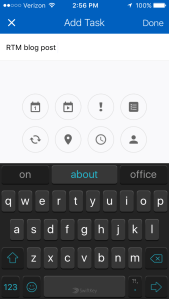
    Remember The Milk Add Task

    Everything is there – you can add every piece of metadata with two taps. Adding due dates at a specific time takes a couple extra taps, and sometimes adding tags requires typing in the first couple of letters, but even when you want to do that, the interface provides enough room that you don’t struggle with it.

    The app I use for Work To Dos (which shall rename nameless), has actually gone backwards in terms of the interface for entering tasks; a big reason I’ve considered moving them over into RTM. Some parts are clean and efficient, some parts feel cluttered and confusing or make me feel like I’m using the app wrong.

    You Can Postpone Tasks Quickly

    Getting Things Done purists will argue that having a due date for most of your tasks goes against the natural decision making process that GTD encourages by discouraging due dates entirely. However, finding a system that works has to be a matter of personal preference: A system that doesn’t fit the exact model prescribed by any productivity guru but that you’ll actually use is always better than a system that conforms to specific rules which falls by the wayside before you even hit a rough patch.

    With that preface out of the way: I use due dates. Mostly because Remember The Milk (like every other app I’ve tried) makes it easiest to view a list of tasks that are due Today. When you open them up, they default to the Today view, so I use a due date of Today as more of a “Next Action” tag than an actual hard and fast due date. (There David Allen, you happy?)

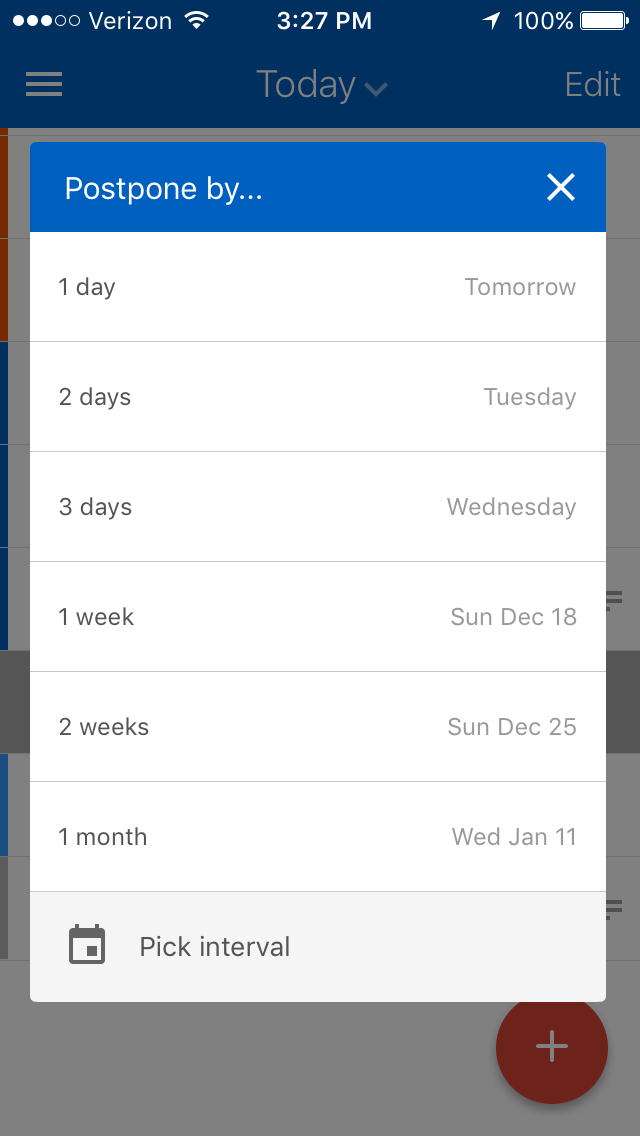
    The only problem with using a due date of Today as a Next Action tag is the next day when the app thinks that a tasks is Overdue. Most apps make assigning a new Due Date pretty easy (which makes sense since they force the Today list on you), but Remember The Milk does it as good as the best and better than most. Witness:
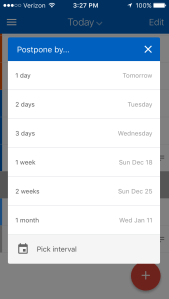
    Remember The Milk Postpone Task

    That’s 6 options right off the bat. Most apps I’ve used provide a decent variety of options for quickly changing due dates, but the ones they provide are not as useful (to me at least). RTM’s options make it easy to say:

    • “This is still a high priority – make it due tomorrow”, or
    • “This isn’t that important, I’ll do it in 2 or 3 days” or
    • “This is something I wanted to do this weekend, but I didn’t get to it and I know I won’t do it during the week, so make it due next weekend”, or even
    • “This was something that I already postponed and I still haven’t gotten to it, so put it off by a whole month”

    And if you don’t want one of the predefined choices, “Pick interval” allows you to pick a date in a number of days, weeks, months, or even years, with a couple taps (instead of having to scroll through one of the date picker wheels that most apps use).

    In the web and native app, there are also keyboard shortcuts that make it easy to postpone tasks (as well as adding new ones – using the punctuation I mentioned in the previous section). All these combos make it easy to keep your list(s) up-to-date and manageable and still focus on the things that need to get done.

    Add To Dos From the Browser on Your Phone

    This is a smaller one, and something that other apps also provide, but again, Remember The Milk it does efficiently and effectively. To get things into RTM, I used to have to email links to myself for entry later, or copy the link on a mobile phone (which in my experience can be tricky). The best part about RTM’s integration is that they have a URL field as a distinct part of the metadata so when you save a link from the web it pre-populates the task with the name of the page and the URL field. All you have to do is pick a date (or not, up to you) and a list (again, not required if you just want to save it to your default list and then move it when you get to your weekly review). The other fields like Priority and Tags are also available when saving from the browser (or not, it depends on the default fields which are configurable).

    URL Field

    I mentioned it above, but it bears repeating. The URL field is key. When you have a repeating task like “Check fantasy team” or “Enter this contest every day”, having a URL as a separate field keeps it from cluttering up the task description (even if it’s a clickable link from that description field).

    Wide Range of Tag Colors

    This is another thing that seems fairly mundane, but when you have a wide variety of tag colors to choose from, it means you can choose a different color (or one shade with a light background to distinguish it from another shade with a dark background) for different concepts and then you can just glance at your list(s) to see what kind of tasks you have to do.

    I use this (though not as consistently as I should) to get an idea if I’m doing the right kinds of tasks. I have different label colors for “finances”, “fun”, “ltg” (long term goals), “writing”, “gtd” (getting things done), “tv”, “profdev” (professional development). If I look at a day and don’t see many colorful little tags next to my tasks, it’s an easily identifable sign that I’m probably working on things that aren’t that important (because they don’t fit into a project or category that I’ve already predefined). I can also see at a glance if I’ve got a good balance of writing and fun and professional development.

    I’d provide a screenshot of that too, but it would take a lot of work to redact all the personal stuff that I don’t want to publish on the web, so here’s one that will give you the idea (from PCMag):

    remember-the-milk-2016

    Hopefully this list has provided you with a little incentive to try out Remember The Milk for your productivity system (though if you’re like me, it probably won’t take much convincing to sign up and at least kick the tires).

  • Does anyone use the word “bonanza” anymore? Anyway…

    giveaway-big

    Welcome to the galactic #SFling September giveaway!

    Twenty-two award-winning, New York Times, USA Today, and Amazon bestselling authors have banded together to bring one lucky winner a fleet of awesome prizes. I am one of those authors, but none of those other qualifiers apply to me… That said, you can still win these great prizes:

    • A Kindle Fire,
    • A $25 Amazon gift card, and
    • The paperbacks and ebooks pictured above (and more!)

    You can get up to 22 entries into the contest by signing up for author’s mailing lists. And for each entry you’ll get a free ebook copy of the book the author has in the giveaway! Yes, it really is that easy and amazing!

    Just Click Here to go to the contest entry page and start entering!

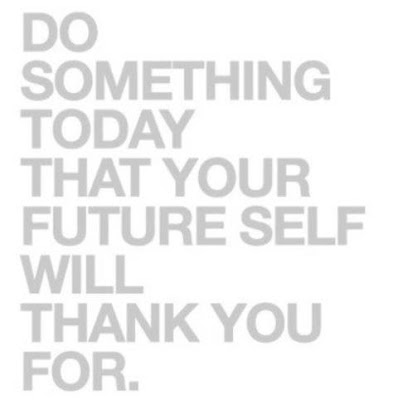
  • Do-something-today-that-your-future-self-will-thank-you-for-white

    Since 2013, when I read about Ramit’s Year of Taking Control theme, I decided I would come up with themes for my years. I actually stole his for the first year just to bootstrap it, but after spending a year with the concept I was able to come up with my own themes that were more relevant to me. (Such high-minded things as: The Year of Finishing and The Year of Awareness.) Sometimes, I have to get into the year a little bit to figure out what the theme will actually be (I try to decide before it starts, but usually something else will present itself as a more natural path to follow).

    As a very concrete example, I thought this year was going to be the Year of Productive Procrastination or the Year of Putting the Time to Work (that is: the time saved by being efficient and organized being used in the most productive way possible instead of just more time to check Facebook). Both of those would have been great. I read an article on overcoming productivity addiction on the Todoist blog and it seemed to fit with either of those themes. Instead of reading more about productivity, I would instead use my system of lists and calendars to make sure that even when I wasn’t working on my highest priority items (like writing the next book in the series), I would still be working on something productive to help me reach one of my numerous other goals. I would finally leverage my system in a more conscious way; being aware in every moment of the time I was saving, the little moments here and there, where putting things on a list or on my calendar, would help me build up a reserve of extra time that I could spend on doing what I really wanted. (If only time could actually be garbage collected like that into more contiguous blocks) I even went so far as to think: Hey, maybe instead of always doing something that is obvious, like opening and sorting them mail, or cleaning the dishes in the sink, maybe I’ll let those things slide until they really need to get done so I can put that time to use in the present instead of trying to save it for some nebulous future.

    Then I read an article on the Todoist blog about strategies for overcoming procrastination. Initially, it sounded either like something that would fit perfectly with my theme, or something that I’d read a hundred times before and would be able to skim in a few minutes. It turned out to be mostly the latter, but also contained the seed of something else entirely. The strategies for overcoming procrastination were actually very good (please read them when you’re done procrastinating by reading this post), but nothing I hadn’t seen before. (Good to remind yourself periodically though)

    But the breakthrough actually came in the background part of the post, where the author – as per usual – quotes some study that someone has done in order to back up the stuff they’re about to tell you. This one went like this:

    Research shows that our brains are actually wired to think about about our present and future selves as two separate people. That’s why we’re able to prioritize our present mood at the expense of our future well-being even though it’s an irrational choice in the long-term.

    A study run by UCLA psychologist Hal Herschel and a team at Stanford University found that participants actually engaged different areas of the brain when they thought about their present selves versus their future selves. In fact, when people were told to think about themselves in ten years, their brain patterns closely resembled those observed when they were asked to think about celebrities they didn’t know.

    This separation of present and future self encourages us to make different decisions about ourselves now and in the future. For instance, one study showed people asked to tutor other students would offer to do so less in the present, but would offer more of their time in the future.

    To sum up the research, we procrastinate because our brains are wired to care more about our present comfort than our future happiness.

    So “Do something today that your future self will thank you for” is not just a good saying for a meme or an inspirational poster. It’s a legitimate scientific concept.

    You think that your future self is someone else.

    So from the point of that realization forward, this has been the Year of the Future Self.

    Evidence of this can be seen if you look at the dates of the blog posts that I refer to above. They’re from February and March. I started this post in April and it’s been 2 months. Because there were things that were more important for me to get done for my future self. (No offense to anyone who reads this blog, but I don’t think anyone is sitting around anxiously waiting for the next bi-monthly installment of my random thoughts)

    Thinking more about my future self has already helped me overcome a lot of procrastination. It actually kind of forces you to do a lot of things that you would see listed in those articles about overcoming procrastination, but I like the change in mindset that comes with it. Eat That Frog! becomes not just a funny way to think about doing something difficult, it becomes a question:

    What is the one thing I can do right now that my future self is going to appreciate the most?

    For me, and especially for my writing, I can ask myself, “How does my future self feel when he comes home from work and his writing for the day is already done?” That is a question I can answer because I know how my past self felt when that happened and it makes it much easier to imagine how my future self will feel. It draws him closer to me, makes him less of a stranger and more like someone who is almost me. And when that happens, I imagine the feeling my future self will have (or the opposite feeling he’ll have when he has to come home to a 0 word head start), and it turns it into something more about my present comfort than my future happiness.

    do-something-womanweights

    So really, I think they key is not just to see that motivational quote on someone’s Instagram and go for a run or do a workout. It’s not eating the frog because that’s what a book tells you is the key to overcoming procrastination.

    It’s about drawing your future self back into your present self. So he or she doesn’t feel like a celebrity you don’t really know. Think about how you’ve felt when you’ve procrastinated or when you haven’t. Recognize that is how your future self is going to feel.

    If I think about how I felt last year when I was falling behind in my writing goals, there was stress. I know how that felt. It’s concrete. I don’t have to imagine it like it’s a future scenario. I know that if it happens again (which it is), my future self will feel that same stress. (It’s totally irrational stress since it’s not like writing is anything close to a full time job that puts food on the table or a roof over my head, but that’s a whole different therapy session blog post)

    When I imagine my future self feeling that concrete emotion, it makes present me stressed. Not as stressed as I certainly would be in the future. But enough to make me think: “It’s worth suffering for another thirty minutes to crank out two hundred more words so that my future self doesn’t have to write those extra two hundred words on top of everything else I’m going to ask him to do.”

    do-something-sunset

  • A couple months ago, I tweeted:

    Well, the changes are moving from mostly aesthetic, user experience enhancements to actual new features. A couple weeks ago, I got one of the usual emails from Goodreads notifying me there was a Giveaway for a book on my To Read list. That happens regularly, but when I clicked through to enter the Giveaway, I saw this:

    Goodreads Kindle Giveaway

    Now, if I were still blogging about fantasy basketball, this would be like the equivalent of Hassan Whiteside’s free agency decision coming up this summer (ie: a big deal to people involved in the game, but fairly meaningless to the general population). I would have been all over it, reporting it as soon as I saw the alert on my phone. But here it’s been a month since the official Goodreads blog post about it, and 2 weeks since I first got the email… It’s probably been reported all over the writing/marketing/self-publishing blogs and KBoards, but I don’t really hawk those like I used to. Plus, this way I get to provide my own, unbiased opinion and analysis. Yay?

    What’s the big deal?

    That little image nestled in there next to the word Format. It says Amazon Kindle.

    Who cares?

    Well, author’s (and publishers) have always been able to give away hard copies of books on Goodreads. It’s a great marketing tool, since Goodreads promotes the Giveaway for you on the site and there are plenty of people who enter giveaways for books in genres they like without knowing anything about the book beforehand. But creating a paperback version (even using Amazon’s Creatspace) is a lot of extra work compared to making an ebook available for Kindle.

    Not only that, but giving away ebooks is a lot cheaper. Giving away a paperback (or other hard copy) costs the base price of the book (printing and shipping). For The Valkyrie Project, that means about $7 per copy given away. In contrast, the Kindle giveaway costs a fixed price of $119 and you can give away up to 100 copies. I’m not sure why you’d do less than 100 if your goal is to get copies into the hands of as many people as possible (which is usually the goal with any indie marketing effort). So obviously, that’s only $1.19 per copy – almost 6 times cheaper.


    So that’s huge by itself, but I also believe that giving away ebooks on Goodreads is much more likely to yield reviews (the lifeblood of books and authors) than making the same ebook free on Amazon via KDP Select. I don’t have any actual proof, but it’s logical because people who join Goodreads do so to keep track of books they’re reading and review them. There’s really nothing else to do there. People on Amazon generally want many other things in addition to books.

    And, as they point out in the blog post, when someone reviews your book on Goodreads (or even most of the time if they just add it to their To Read list), it will show up in the feed that all of their friends will then see on the site.

    Once this rolls out to the general author population on Goodreads, Amazon will have provided authors with yet another fantastic marketing tool. And now is the part where you can chime in with your worries that by giving away only Kindle copies, authors and readers are locking themselves into Amazon’s platform. I am well aware that is exactly what Amazon is trying to get everyone to do. But it’s not any different from, as one of thousands of examples, Apple Music giving away 3 months free to try to get people to join that service, or Tidal music getting Kanye’s album exclusively for 2 weeks before everyone else to try to get people to join that service. I don’t want Amazon to gain a monopoly on ebook sales, for sure, but I also hope that people who worry that Amazon is going to begin acting like a monopolist and exploiting authors remember that without Amazon, there likely wouldn’t even be a market for ebooks big enough to sustain the careers of as many authors as now make a full-time living from their writing. (I’m certainly not one of them, nor do I ever think I will be, but I am happy that writers now have that option and can actually earn a comfortable living as a midlist author instead of living on ramen until striking gold and then eating only cavier)

    Really, this is just another step in the evolution of Goodreads, Kindle Unlimited, and Amazon as a whole, an iterative process in which Amazon figures out (or guesses) what customers want and gives it to them. And while it may not be exactly what authors want (for example – you don’t get the contact info for winners of the Giveaway), smart authors will use it to get what they want (by putting email list signups links in their ebooks, or perhaps making note of the winners on Goodreads and following up to see if they leave reviews on the site).

    Bonus New Feature

    Something else Amazon/Goodreads added in May was Goodreads Deals. I’m hesitant to say that this feature will be much less important/impactful than Kindle Giveaways because I feel like it could turn out to be just as big a deal in the right circumstances (and in the perfect circumstances, even more so). But, it isn’t clear — even from the blog post aimed at authors and publishers — how books get listed as Goodreads Deals in the first place… Indie authors can’t discount prices on ebooks. They can only price their ebook relative to their paperback version to make it look like a better deal than getting the hard copy.

    If the Goodreads Deal becomes something that can be sent out when an author makes use of their Kindle Countdown days on KDP Select, then it will be a useful way to contact potential readers (especially if you get a lot of people to add your book to their To Read lists by chaining it with the Giveaway feature above).

    The more likely option, when beta testing is complete, is that Goodreads Deals will be similar to rental lists from sites like Bookbub or Freebooksy, where authors can apply to be part of an email blast (and probably give Amazon some money for the favor). One clear advantage that Amazon has over the other free and discount book lists is that it gets a 30 or 70% direct cut from all of the books sold, rather than just an affiliate fee. In order to appear somewhat more impartial, they do allow for deals on the other major ebook retailers, but Amazon certainly knows that they have 60-80% of the ebook market, so they can afford to include the other companies. It’s a small price to pay to please Goodreads users and continue to have the opportunity to eventually move them into the Kindle and Amazon ecosystem (through the Kindle Giveaways, of course).

    monopoly

  • One of the first things that any independent publisher giving advice to other independent publishers says is: Write a good book, have it professionally edited, and get a good cover for it.

    Those are the three central tenants of self-publishing. I’m not going to even bother looking up and linking to references because I’ve seen it on just about every site I’ve ever read about self-publishing (sometimes multiple times).

    The other thing I see on most of the sites dispensing that advice is a lack of supporting evidence. By that, I mean: How does anyone know that these are the most important things to publishing a book? Is there an experiment that can prove it?

    Unfortunately, I don’t think there’s a way to quantify whether you’ve written a good book or not. I suppose you could write a book, throw it up on Amazon and watch your numbers for some amount of time… then somehow “make it better” and upload the new, better version and see if you sell more copies. Theoretically, if you did end up selling more without changing anything else you’re doing, then you could attribute the increase in sales to the fact that people reading it are recommending it more to friends who then buy it. That’s a tenuous connection, and it assumes, as stated, that you don’t change anything else you’re doing. Not only that, but you’d have to make sure you don’t get any new reviews on Amazon (or Goodreads) because those negative or positive reviews will certainly influence whether or not someone discovering the book will buy it. (Since that’s exactly what the rating system is designed to do)

    There are a lot of other outside factors that would have to be controlled, but even if you could plausibly eliminate some external variables as causes for an increase in sales, it’s going to be a pretty painful experiment and one that I’m pretty sure no author would willingly take on unless it was under a pen name. The same thing applies to professional editing. You could put up a book that hasn’t been professionally edited, and see how it sells, then have someone edit it and see if your numbers go up. The same restrictions and caveats apply to this case.

    So that leaves the book’s cover.

    I imagine it’s hard (especially for those authors who are writing and promoting a lot more than me) to devise an experiment where the only variable is the cover. But as someone selling in the single digits per year with only one book out (last year, this was), and doing basically 0 promotion, it was actually pretty easy for me.

    The numbers below will probably make people laugh, but I’m posting them so you can see the actual values and not just a hand-waving conclusion to my bold experiment. I’m also posting them just to be honest with other indie/self-publishers who will (hopefully) end up on this page at some point. This can be the reality of it if you’re not good at marketing (or if I’m really being honest, just don’t want to put the time into it) and you only have one book out. (My reading on the subject tells me that the 4th rule of self-publishing is: Don’t bother promoting if you only have 1 book. It’s much better to hit it big when you have a bunch of books out.) Lucky for me, I have a day job with health insurance that pays well enough that I’m not a starving artist. In fact, I usually have more calories available to me than I could possibly consume on a regular basis, so I have to work out and eat right or I’ll end up as the opposite of a starving artist. Now, perhaps if I were a starving artist, and writing books to sell was the best option I had for making money, then I’d skip the extra hours that I put in at work and spend more time marketing. But that’s kind of a whole different blog post… so let’s proceed.

    Book Cover Experiment

    From 2012 when The Valkyrie Project was originally published until November of 2015, I had this cover:

    valkyrie-project-cover-200w267h

    I thought it was pretty decent considering I had done it myself. I still think it is decent considering I did it myself, but decent doesn’t sell books in this day and age.

    And as proof, with that cover:

    January 2015 – October 2015 sales (before cover change): 3

    There’s no missing 0 there. It’s just 3.

    I uploaded a new cover – no other changes – at the start of November 2015. It looked like this:

    The Valkyrie Project final ebook cover

    November 2015 – December 2015 sales (after cover change): 12

    Yes, I went from 0.3 books per month to 6 books per month simply by changing the cover image.

    Now, with only 15 total sales, I’m sure some statistician will say that I don’t have a big enough sample size, but I think the dramatic increase in sales makes up for that fact. Especially considering I did nothing different in those two months.

    “But wait!” the astute among you will say, “Didn’t you release another book at the end of 2015? Certainly that had some effect on the sales numbers! Your experiment is not as flawless as you claim!”

    Yes, I did in fact release a book at the end of 2015, but the 12 sales from November to December all took place before I announced that book and even before it was available on Amazon. So while you steely-eyed bean counters are correct in part, the addition of that book to my inventory did not have an effect on the 12 sales of the Valkyrie Project.

    Weathering The Past has done pretty well since it’s release, most of which I attribute to the cover:

    Weathering The Past Final

    I am sure it’s harder to sell the second book in series (and I have heard/seen anecdotal evidence to support that), so the fact that I’ve sold more copies (15) of Weathering The Past in the first 2 months than I did in 3 years (up to October 2015) with The Valkyrie Project makes me happy (even though it has no bearing on nor relevance to the above experiment). And honestly, now that the book(s) is(are) actually selling a bit, it has inspired me to increase my output and stay focused instead of bouncing around between projects as I have been doing probably a bit too much recently. But that also could fill a whole other blog post.

  • NaNo-2015-Participant-Badge-Large-Square

    I still haven’t “won” NaNoWriMo, but every time I do it, I get a little bit closer. And even though I never win, I learn a lot, which is what allows me to get even closer on the next try.

    That said, let me share my “tips” such as they are, which in this case are intended mostly to encourage fellow writers who might be perennial “losers” like me.

    For me, it’s NeWriMoMo

    It’s a subtle difference. I am sure there are plenty of NaNoWriMo purists out there. “You must start at the beginning of a novel and write 50,000 words of that novel.” Sure, that’s cool. If you don’t write during the rest of the year and you haven’t developed a more customized, personalized approach. For me, NaNoWriMo is just a time when I put aside pretty much everything else and just focus on writing. NeWriMoMo: “Ne”ls “wri”tes “mo”re than he does in other “mo”nths. If you can crank out a book in November, then go on to revise and publish it and have a one book per year output, more power to you. There’s no way I can do that. First off, I’ve only ever gotten 35,000 words in a single month, which is barely half of a short novel. Second, I’ve found that I like to bounce around between books when I get stuck. I know that this is anathema to a lot of writers, and most especially to writers who like to give advice. They want to write a book straight through and finish and have it published, and I understand that. But this is about me writing more than I usually do. It’s about trying to get 50,000 words. I don’t expect anything from NeWriMoMo to be even close to publishable (after revision, sure, but not in any relatively short time frame).

    Think about the mathematics of it (because that’s what I do). Say I write 10,000 to 20,000 words across 2 books in an average month (20,000 being on the very high side). If, in November, I write 10,000 words across 5 different books, then it’s still 10,000 more words than I would have had on 2-3 of those books and about what I would have done on the other 2-3, so it’s still a net positive. I’m not hurting myself compared to my normal output.

    Perhaps it’s a poor analogy, but it’s kind of like when people talk about the “Fat Burning Zone.” I’ve seen advice that people should run slower when working out to keep their heart rate in the “fat burning zone.” That’s great for people who are just getting started running because it allows them to actually get into it and do it. But for people who have been running a while and want to really burn the fat, running faster will burn more calories. Even if that means you’re burning more calories which are stored in carbohydrates and protein, you’re burning more calories overall, so you typically end up burning more fat calories as well. (Of course, then it also helps if you eat a higher proportion of carbs and protein so that you don’t just get back all the fat calories you worked so hard to burn, but still, like my writing, it’s a net positive)

    And besides: I prefer Christine Carter’s approach of “The Easiest Thing” (from her book The Sweet Spot). The idea is: in order to get yourself to start doing a new habit, start with whatever is the easiest possible thing. I believe one of her examples was, if you want to start running, put on your running clothes and go outside. If you don’t feel like running, you’re already in your clothes and outside, so maybe you’ll just go for a walk? Or maybe you’ll just go back inside. (I may be totally mangling that example, but it’s the idea I’m going for) Same thing with my writing. What’s the easiest thing in writing? Sit down at my computer and look at Scrivener (I leave the app open so I don’t even have to click to open it because that would make the easiest thing a little bit harder). Once I’ve gotten that far, I know the next easiest thing is to write a sentence. And once I write a sentence, the next sentences start to come. And sometimes they don’t. If that happens, I’ve got other projects to look at. I’ll flip through open projects until one of them strikes me.

    Okay. Yes. I know this is not the best way. But it’s only during NaNoWriMo that I allow myself more than 2 (or 3) projects. During my normal writing I’ve usually got 2 fiction projects (usually similar in genre so I don’t have to context switch as much), and 1 sort of non-fiction. During NaNoWriMo, I’ll usually add another fiction project from a previous NaNoWriMo that I only work on during NaNoWriMo, and another fiction project which is brand new so I’ve got plenty of open road ahead of me.

    I know this works for me. It’s not just a whim. It’s a defined method/process I’ve created to increase my output in a systematic way. So besides allowing yourself to just break the rules of NaNoWriMo by working on a novel that’s already in progress and/or working on several different novels, my advice is to be aware of how you work and don’t restrict yourself to working one way just because you think that’s how writers are supposed to do it. Writers are artists, but at the same time, they have to produce something if they want to sell it. So the ability to create that balance between the creative and logical sides of your brain is important to develop.

    Don’t be afraid to experiment with ideas, your process, and your life. When I first started drinking protein shakes, I tried making them by – as the name suggests – shaking them. It didn’t work. They came out all clumpy and borderline undrinkable. So I switched to using a blender and they turned out much better. “Great story Nels,” I can hear you saying, but that’s not the end. Not much later, I found a better tasting and even healthier protein powder. But I continued using the blender and didn’t even think to go back and try the shake method with the new powder until my wife final got lazy smart enough to just be like “I’m just going to shake one and see if it works.” Lo and behold! It worked like a charm bracelet on the horn of a unicorn. Now, imagine that your books are different kinds of protein power and your writing process is shaking them up. The process that makes an unreadable word soup out of one book might make something smooth and delicious for your reader’s brains with that same process. But you won’t know unless you try.

    A Writer’s Season Never Ends

    At the end of NaNoWriMo, I’m still trying to write 800+ words/day to reach my goal for the year. Part of that is because I spent a lot of time earlier in the year revising Weathering The Past (Book 2 of The Valkyrie Project series), and part of it is because I was tired after all the revising and let myself off the hook a little too much.

    But a Writer’s Season Never Ends. As much as I’d like the revision of a book to be the playoffs and the publication to be winning the championship, I don’t yet have the rhythm to make that analogy work. And while it might actually be a decent analogy if you stretch it a bit, writers don’t really have a regular season either. The off-season and the regular season are pretty much the same. You don’t get to take a break. I read an article in Chicago Magazine about Jimmy Butler’s off-season and his schedule of waking up at 5am every day and practicing three times a day sounds a lot like my writing schedule. I’m writing this post at 5am, and I write on the train or at lunch and – especially during NaNoWriMo – I force myself to write more after work even when my brain is dead and my words/hour rate slows to about 100. There’s no part where you show off in front of an audience (certainly not while traveling the country). If that sounds like a book tour, then it means the regular season comes after the playoffs and the championship and so the analogy is fundamentally broken. In which case, I’ll repeat it again: A Writer’s Season Never Ends.

    But don’t worry too much. Because if you attempted NaNoWriMo – even if you didn’t win – it will be much easier to keep writing now. After reaching for 1,667 words per day, trying for 800 seems almost pedestrian. It’s like playing ball against Jimmy Butler for a month and then going back to play at your local gym.

    easy_button

    Bonus Tip

    Get Hulu Unlimited. During November, I had to try to keep up with Blindspot and Agents of SHIELD (pretty much the only two shows I watch anymore). With Hulu Unlimited (aka No Commercials), I was able to crank out an episode in less than 45 minutes while I did elliptical; multi-tasking which allowed me to get back to writing that much faster. Before the no commercials option, I would be there for at least 50 minutes, which is a long time on the elliptical, believe me. Or I’d have a show with 5 more minutes that I needed to watch. (I had to watch them in November because even with Unlimited, the episodes still expire so you have to keep up within the last 5 episodes). Outside of working out, it’s totally worth the $4/month for the time savings on watching shows with my wife. I haven’t actually calculated the ROI in terms of amount paid for time saved, but at about 13 cents a day, it doesn’t take much. And no, I don’t work for Hulu or any TV networks or anything else affiliated with Hulu. I just happen to like TV as well as being efficient.

  • For those reading in real-time: Yes, I am posting this right before Thanksgiving for a reason. 😛

    In The Valkyrie Project, and it’s sequel Weathering the Past, our protagonist — Ana Callif — does some fairly routine ass-kicking, at least by today’s standards. She fights (a lot), runs (a lot), jumps, sneaks around, and fights (some more). Even scurrying across the roof of a skybridge over dozens of lanes of flying cars has become a bit believable when you’ve got twenty years of Ethan Hunt and Jason Bourne (and let us not forget another 30+ years of James Bond) under your belt.

    But I’ve started working out (more than just running/elliptical) this year (actually since last December), and after being a runner pretty much exclusively my entire life, I have come to realize that these agents of espionage must have a pretty killer training plan that we never actually get to see or read about. It’s not like Rocky where the training montage is expected so you can see how hard he’s working. Even the recent Daredevil series just kind of goes with the assumption that: He’s blind, so his heightened senses also include increased heart size and red blood cells that can carry oxygen to his muscles faster during anaerobic activity. He doesn’t have to go to the gym and do jumping lunges or mountain climbers or sumo squats. Just as Ana can sprint up a hill while being shot at or wrestle some dude in an elevator or sprint up way too many stairs (or any number of other crazy ridiculous stunts which I’m trying not to spoil for those who haven’t read the books), she also is never shown lifting a finger outside all these missions. I definitely think the missions help to keep her in shape, but there’s no mention of push-ups, burpees, weights, or duck walking. Yet if she wasn’t already prepared for the task physically, I don’t think the Agency would even let her out the door.

    So, how do these people get in shape in the first place?

    In this post I’ve put together my hypothesis in the form of a workout. It’s similar to workouts I’ve seen and done (which kicked my ass), so while I’m not a certified professional trainer or anything, I’m fairly sure this would get you into, if not World Class Super Spy shape, then something much closer than most of us probably are now (myself included).

    The Valkyrie Project Workout

    We’ll start with a warm-up and then 3 circuits (though the Valkyries probably do it at least twice through depending on how much time they have). The circuits are only about 7 minutes each. They’re intended to be hard and you do them as hard as you can. Get that heart rate up and keep it up while you work those muscles. When you’re training to be an International Super Spy, you don’t have all the time in the world to work out (I’m going with that assumption, even though really, you probably do). You’ve got to read a lot about missions, study other languages, learn to imitate other people, practice walking in heels (if you’re a Valkyrie), hit the gun range, and then take a long flight somewhere. So you’ve got to keep your workouts short and to the point.

    In the interest of efficiency again, you will need at most a set of hand weights for these moves (though most don’t require any weights).

    Warm-Up (30 seconds each – twice through)
    Backward Swinging Arm Circles (Big rotation)
    Half-squat with leg rotation (ideally with knee straight and full rotation) – This is just a half-squat with a chorus line kick
    Static lunges with torso rotation (with hand weight)
    Leg swings – one leg at a time, swing it out to the side while keeping your body straight up and down

    Circuit 1 (30 seconds for each numbered exercise)
    1. Half Crow Push-ups – 30 seconds; bend one leg and bring it toward your elbow as you do a push-up
    2. Kettlebell swing with squat (you can use your hand weight as a kettlebell)
    3. Sumo Squats with overhead tricep press (tricep extension)
    Repeat 1-3
    4. Mountain climbers
    5. Burpees
    Repeat 4-5
    6. V-sit into Hollow Ab Lift (similar to Hollow Rock but with a bit more control going from the V-sit to the Hollowed out position)
    7. Plank twist

    Circuit 2 (30 seconds for each numbered exercise)
    1. Superman with shoulder press (hand weights)
    2. Renegade row with push-up
    3. Forearm plank push-ups
    Repeat 1-3
    4. Squat jumps
    5. Plank moguls
    Repeat 4-5
    6. Pike crunch (raise legs and touch toes)
    7. Sit-up with leg extension (alternating sides – kind of like a bicycle sit-up)

    Circuit 3 (30 seconds for each numbered exercise)
    1. Duck walk
    2. Chair pose with reverse fly (this is a combo, so you might have to search for a couple videos to get the idea)
    3. Side lunge with front raise
    Repeat 1-3
    4. Double-time butt kicks (basically, as fast as you think you can do them, double that)
    5. Jumping lunges
    Repeat 4-5
    6. Sit-up with Russian Twist
    7. Roll-up followed by pike crunch

    Cool down
    Always important to stretch things out after a work-out. Most people do this by stretching whatever hurts for about 5 seconds, and with time so limited, you would think the Valkyries would probably follow that routine as well. Well, some of them do, I can assure you. Ana is probably one of them. But some of them follow the prescribed stretching routine, which is as follows…

    Standing Hamstring Stretch – Place one leg at a time on a chair and lean forward to stretch hamstring; 90 seconds each. Keep back straight when leaning in to stretch. You can do this seated on the floor with one leg bent if you want.
    Standing Quad Stretch – One leg at a time for 90 seconds each.
    Crowd Pleaser – Stretch for the groin: Sitting on the ground place the soles of the feet together and lean forward. Hold for 90 seconds. (Noticing a pattern here?)
    Standing Calf Stretch – Place hands on the wall or back of a chair. One leg forward, the other straight back. Try to keep the heel on the ground for the best stretch. Hold each leg for… 90 seconds! No deviation here.

    So there you go. And yes, I did just basically pick all the hardest moves that I know of and string them together. But I did actually do this workout after designing it to check if it was really as hard as I thought it would be, and actually is was quite doable. Certainly not easy – it’s harder than a lot of similar workouts I’ve done, but I’m sure if I wanted to spend five minutes searching instead of making up my own, I could find a lot of harder workouts. But they wouldn’t be called the Valkyrie Project workout, now would they?

  • Writing Playlist Covers

    As Weathering The Past nears readiness for publication, I’m trying to figure out ways to market it without just pimping the book directly; to say something besides just “buy my book!”

    So, to give you an idea of the different aspects that went into writing the second book in the The Valkyrie Project series and, honestly, just to share some music that I really like, I’ve made the playlists that I used when writing Weathering The Past public on Spotify. (Since Spotify is free, I believe anyone should be able to listen just by giving them your email address – or a fake email if you really want)

    I think (okay, I know) most writers have playlists that they use when writing to get them in the right mood or mindset. I don’t remember seeing any post more than just a single album, artist, or playlist for their writing, though. I’m guessing they have them, but they’re just trying to be concise. Since the scenes in my books vary in tone and emotion (I hope!), it definitely helps me to have a particular playlist to help with the kind of scene I’m writing.

    For Weathering The Past, there were three main types of feelings that I wanted to get. Not all of the scenes match up to one of these three exactly, but for the most part, I found that three lists was a good number to work with. The first… well, there is a lot of action in the book. So, I needed a playlist that would get me psyched up. I considered using Barney’s Get Psyched Mix from How I Met Your Mother, but it’s a bit heavy on the 80’s and I like to stay current on my music. So, I seeded a playlist with some classic Get Psyched songs and then slowly evolved it, adding new songs to replace ones that I got tired of, to end up with the current Valkyrie Project – Amped mix. You’re lucky because I went through a bit of an EDM phase in the middle, most of which has been culled, replaced with songs that I think are generally more palatable.

    The next most prevalent emotion was ‘tension’ or ‘drama’. This generally meant slower, quieter, and mostly instrumental tracks. Selections from a lot of movie and video game scores. Some of these were used for action scenes as well, but the kind of action scenes where something very dramatic is culminating or coming to a head. I think you’ll get a good idea of what I mean when you hear it… Valkyrie Project – Dramatic.

    Finally, there is the Valkyrie Project – Emotion list. This was used for scenes where I was trying to rip tears from the eyes of readers. I don’t think there’s as many of those in Weathering The Past as compared to The Valkyrie Project, though. That was a conscious effort on my part to make it a bit lighter, include more ‘fun’, and go with more of the scenes that would fit into the ‘Dramatic’ playlist rather than ‘Emotion.’ Based on feedback from the early readers who have finished both books, I don’t think I did as as good a job of that as I wanted, but the overall feedback was very positive for the second book, so I’m not going beat myself up too much.

    As I begin work on the third book in the series, I will continue to listen to and to evolve these playlists, so go ahead and ‘Follow’ them to take advantage of Spotify’s excellent notification system.

  • Before I instruct on the surprisingly simple art of acquiring audiobooks in a remarkably monetarily efficient manner, let’s get 2 things out of the way.

    1. This post presupposes that you don’t need to purchase a particular book at a specific time (e.g., as soon as it comes out). For example, I have 700+ books on my To Read least in Goodreads, so reading a new book by an author (even one that I really like), is not something that I generally do. I actually plan the books I’m going to read a year in advance (call this obsessive if you like, but I do allow myself to deviate from that plan. I just like to have goals and I’m a slow reader, so if it’s important to me to read a book, then I want to make sure I get to it). Okay, so if you can also wait patiently for a Twitter or Facebook or email announcement that an author or their publisher has discounted one of their books, then you’re halfway there.

    2. The second prerequisite is that you prefer audiobooks to the exclusion of almost anything else. For me, this is more out of necessity than anything else. If I’m going to sit down with my iPad or my Kindle Paperwhite (or any other eReader), it’s almost certainly because I’ve got a technical or programming book that I need to (and sometimes even want to!) get through. So in order to “read” fiction books, I have to make use of times when I’m cleaning the floors, or weeding, or mowing the lawn, or even just walking to work.

    Okay, so, given that you’re still reading, or skipped over that part to get to the goods… It’s really quite simple.

    Cheap Audiobooks

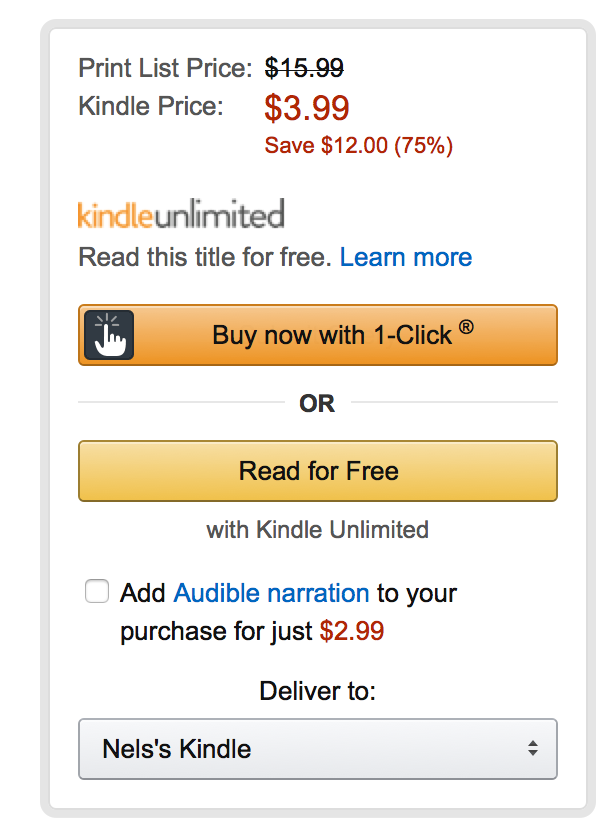
    Say, for example, that you – like me – have heard good things about Starship Eternal, so you head to Amazon to check it out…

    Screenshot 2015-05-30 13.26.21

    If I was in Kindle Unlimited, I could read the Kindle edition for free, so that’s probably the ultimate cheapskate way to do it. I have a “shipping only” version of Amazon Prime that I got because someone “shared” it with me, so as long as they keep paying for full Amazon Prime, I get my Prime shipping but no Amazon Instant Video nor Kindle Library nor Kindle Unlimited nor anything else. Plus, remember, I’m a slow reader who relies on audiobooks anyway, so the Kindle edition, while the cheapest option at $3.99 is going to cost me reading time on other books that don’t even have an audiobook. (Can you imagine Java 8 in Action in audiobook? Spoiler Alert: It’s not going to work.)

    But the audiobook version is $26.95 (or $14.95 if you subscribe to Audible). That’s a big difference.

    Luckily, there’s an easy way to close the gap…

    Screenshot 2015-05-30 13.26.06

    Wait – does that really say “Add Audible Narration for $2.99” when you buy the Kindle edition?

    Indeed it does.

    And $3.99 + $2.99 is much less than $26.95. Less than $14.95 too. In fact, it’s more than 55% off the Audible subscriber price!

    And that’s really all there is to it. I’ve done it for 10 different books now and the only consequence is that I’ve got a lot of great audiobooks to read.

    Here’s another even more extreme example:
    Screenshot 2015-05-30 13.32.36

    You can get The Winds of Khalakovo for $2.98 vs $29.95 for the Audible edition by itself.

    And just to clarify, this isn’t just for author’s who are offering these books themselves (independently published). I’ve bought Perdido Street Station, Blackbirds, and No Return like this. If you go check right now, all of those are a lot more expensive, but since we’ve already assumed that you don’t need to buy one of them right now, you can wait until the author or publisher decides to throw a discount your way and then go take shameless advantage.